
The NI dazzles in Faculty Publication Awards


The recent UCT Faculty of Health Science Publication Awards saw two NI members impress with their publications from the 2024 cycle. Two types of awards are offered, three Postgraduate Awards and three Early Career Awards. The prizes in each are given foreach of the following three fields: Clinical Sciences; Basic Laboratory Sciences; and Public Health & Rehabilitation Sciences together with Health Sciences Education.
Six hotly contested awards in total. And it's easy to see why when considering that the Faculty consists of 14 academic departments, over twenty multi-disciplinary research groupings, and more than 5000 students.
Our heart-felt congratulations to all the winners on their exceptional achievments, we were very proud to have the NI represented in a third of the awardees. Our extremely worthy winners were as follows:
Dr Catherine Wedderburn, a postdoctoral researcher in the Neurodevelopment Research Group of Professor Kirsty Donald, won an Early Career Award for her publication in the 'Clinical Sciences' category. Her paper, entitled 'Association of in utero HIV exposure with child brain structure and language development: a South African birth cohort study,' was published in BMC Medicine 22, 129 (2024). Her Award comes with a R10 000 cash prize that must be used for research.
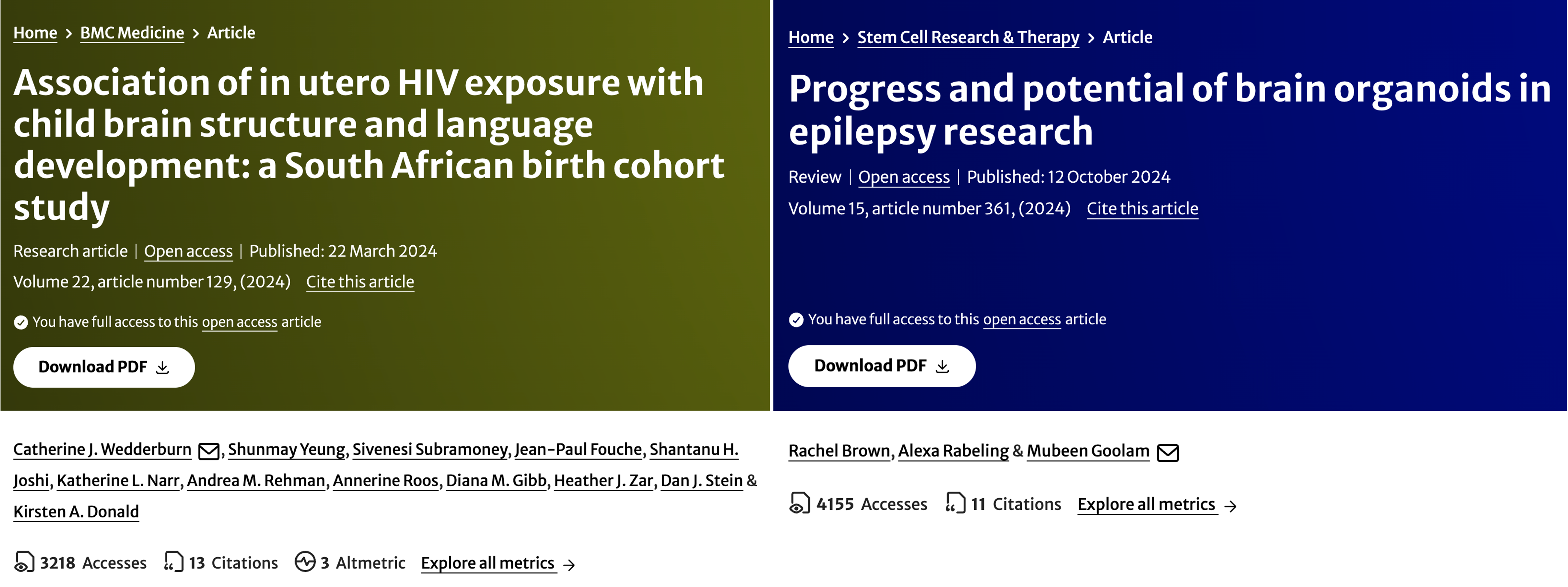
Rachel Brown, a PhD candidate in the Brain Orgnaoid lab of Dr Mubeen Goolam, won a Postgraduate Award for her publication in the 'Basic Laboratory Sciences' category. Her review paper, entitled 'The Progress and Potential of Brain Organoids in Epilepsy Research,' was published in Stem Cell Research and Therapy in October 2024 and already has 11 citations. This review outlines the use and potential of brain organoids (which are 3D aggregates of neurons and glia formed in culture) to study epilepsy in vitro, and speaks to the promise of 3D stem-cell-based models (such as brain organoids), to study neurodevelopment and neurodevelopmental disorders. Brain organoids are a high throughput model, that can be produced at relatively low cost, and have increased relevance to the human developing brain, compared to animal and 2D cell culture models. They also reduce the ethical concerns associated with the use of human brain tissue.